

Breaking the Culture Barrier in Postmerger Integrations
By now, it’s conventional wisdom: culture can ultimately break even the most seemingly harmonious corporate match. The list of mergers that have faltered or failed because of culture clash is long.
There are several reasons why so many companies fail to address something so fundamental to a merger’s success. For one thing, culture can seem vague. Most people don’t know how to deal with it in an analytical, systematic, and practical way. In addition, in the midst of a merger, most executives are already stretched beyond capacity.
We have identified four proven practices that will lead to much more successful outcomes during and long after the integration. First, companies must identify cultural differences. Doing so is a critical first step in a PMI, and ideally one that should happen well before the integration begins —even during due diligence, if possible. Second, and equally important, companies need to commit to addressing these differences at the outset, given their profound impact on everything from talent retention to sustaining value. Third, it’s essential to take a systematic approach to addressing cultural differences. Finally, companies must migrate to the target culture while preserving and harnessing desirable differences and making sure to measure success.
Identify Cultural Differences (Focusing on Behaviors)
Most executives expect some cultural differences between two merging companies. But generally they don’t know the extent of those differences and what they really mean. (See “Differences Are the Default.”)
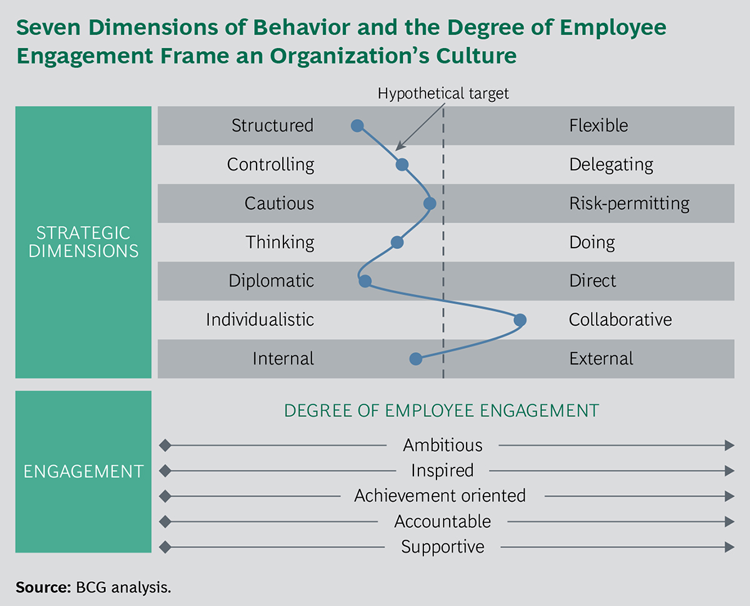
Four major patterns emerged:
Cultural differences are common even within the same industry. In every deal involving companies from the same industry, we found cultural differences. In half of the deals, there was a material difference in at least one key strategic dimension. One-third of the deals revealed substantive differences in at least three dimensions.
Company trumps country. Culture is more a function of company than of country. In 80% of the deals examined, we found marked differences between a company’s divisions within the same country.
The higher up in the ranks, the greater the differences. In most dimensions, senior managers showed differences two to three times greater than nonmanagers.
Commit to Addressing the Differences Now
Capturing the Value of the Deal. The characteristics that make a company an attractive merger target are reflected in the way people work —in how the organization gets the job done. In other words, culture is often the underlying reason for the deal. As part of the merger, an acquirer will often make numerous organizational changes to the target. But by changing how people work at the target company —and ignoring its culture— an acquirer can unwittingly destroy the target’s value. Preserving desirable elements of the acquired company’s culture requires deliberate and thoughtful effort.
A major industrial manufacturer we worked with had acquired a high-growth company in order to access its customer base and Retaining Talent. In any merger, people from both organizations are expected to go above and beyond their “day job” requirements. And they will do so, if they are engaged (for example, if they are motivated and feel accountable) and if they are inspired by the company’s purpose. When culture clashes are left to fester, it’s easy for people to get frustrated and for engagement levels to drop. When deep differences remain unreconciled —or critical traits are neglected— talent will head for the exits.
Avoiding Perpetual Integration Mode. When cultural differences are not tackled from the start —overtly and with a clear plan— employees will cling to their legacy-company identity. This forces the new entity into perpetual integration mode, unable to move ahead as a newly constituted organization. Ultimately, either the acquirer destroys the culture of the target company, or —in the case of a bona fide merger between two similarly sized entities— the two never fully combine. In times of pressure, employees revert to their former behaviors and are unable to work together effectively.
Take a Systematic Approach
Identify the cultures. Step one involves conducting a “cultural beliefs audit” —ideally before the close of the deal, but certainly as early as possible so the results can be acted on from the get-go. This diagnostic consists of interviewing and surveying executives and senior managers (and, in some cases, selected middle managers) from both companies to assess their characteristic behaviors and level of engagement. The results can be plotted and graphed to show how similar or different the two companies’ cultures are at different management levels. (See Exhibit 1.) The exercise provides a common language with which to discuss cultural factors that are often difficult to clearly describe.
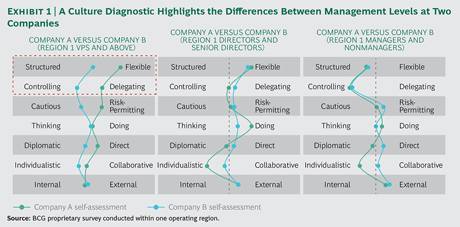
The results of the cultural beliefs audit should be high on the agenda of the integration team’s workshops. The team must reinforce common values and behaviors, and identify and discuss any values and behaviors that differ between the two companies. Leaders should then find specific ways to resolve culture clashes up front.
Align on the desired culture. Once the new team is in place, leaders can quickly create cohesion by holding a series of workshops to align on the vision, strategy, and purpose of the combined entity. Translating that vision, strategy, and purpose into a set of behaviors is the way to foster the desired culture. For instance, if the new strategy calls for putting more leading-edge products on the market faster, you will need to establish a culture that promotes innovation —one that enables people to take more calculated risks and that supports the ability to execute quickly.
Identify the elements of the organizational context that reinforce the desired behaviors —and make a plan. Banners like “Better together” won’t encourage strangers to collaborate. Context is what drives culture.
Many elements make up an organization’s context: its leaders (and the behaviors they exhibit), its structure, its systems, its incentives, even the nature of the informal interactions that take place among its people. BCG has identified seven such elements, or “context levers,” that influence key aspects of behavior —and in that way, shape culture. Among them are the style and actions of a company’s leaders, organization design, people and development (how talent is promoted and what kind of people are recruited and hired), and the performance management system. So, for example, if you want to preserve the innovation-mindedness of your acquisition, you will need to consider all the aspects of its organizational context that foster the underlying behaviors —and keep the critical ones in place.
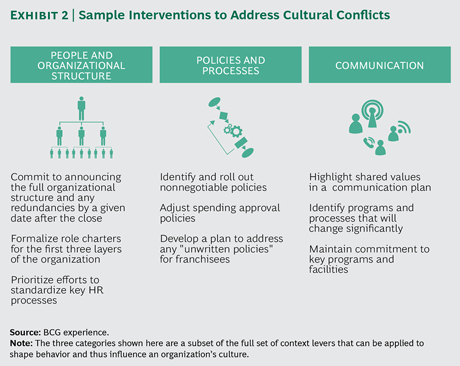
Without a fundamental understanding of how context drives behavior, it’s difficult to see how the decisions made during a merger will shape the culture of the combined entity. So to diagnose the two cultures properly —and lay the foundation for ultimate postmerger success— it’s crucial to understand more than the behaviors themselves. You must also understand which elements of the organizational context are driving those behaviors. BCG recommended a plan of action that focused on three broad categories: people and organizational structure, policies and processes, and communication. (See Exhibit 2.)
Migrate and Measure Success
Migrating to the target culture will take time, but it should start as soon as possible in the planning phase —even before the deal closes. Analyze the behavioral differences, define the cultural aspirations, and identify ways to bridge the gaps. Prioritize your actions and initiatives, creating implementation “waves” that will help the new cultural imperatives gain traction over time. Start with quick wins: a president’s award that rewards desired new behaviors, a switch in office seating to inspire a new type of collaboration —anything that can inculcate the desired behaviors from day one.
Conduct a broader culture diagnostic. Before the close, because of limited access, the culture diagnostic can often be conducted only with the senior leadership team. After the close, however, you’ll want to survey a representative sample of the whole organization to understand cultural differences at a deeper level —and amend your action plan accordingly.
Measure the success of cultural changes as closely as you measure synergies. How you measure the success of the business should also determine how you manage the success of the integration. What business objectives indicate whether the target culture has been reached? If, for instance, the focus is on innovation, you’ll need to identify metrics such as the number of ideas in the development pipeline, time to market for new products, or even conversion and success in attracting the right innovation talent from target schools. If customer centricity is an essential part of the strategy, you might want to consider metrics related to customer satisfaction and retention, or the time needed to resolve customer issues.
Cultural differences can be managed and overcome if they are properly addressed in an analytical, systematic, and practical way. And that’s a good thing, considering that culture is a key enabler of the new organization.
Similars
- Digital Transformation - Customer journeys
Fatal error: Uncaught TypeError: mysqli_fetch_assoc(): Argument #1 ($result) must be of type mysqli_result, null given in /homepages/7/d566817798/htdocs/NewWeb/IHR_WEB/pagina.php:152 Stack trace: #0 /homepages/7/d566817798/htdocs/NewWeb/IHR_WEB/pagina.php(152): mysqli_fetch_assoc() #1 {main} thrown in /homepages/7/d566817798/htdocs/NewWeb/IHR_WEB/pagina.php on line 152